
Last reviewed: 25 July 2026
In brief: On this monthly-average measure, the UK gold price increased from approximately £1,017 per troy ounce in July 2016 to approximately £3,171 in June 2026. That is a rise of about 212%, although it should not be treated as an investment return or a guide to what will happen next.
The chart below shows the gold price over the last 10 years in pounds sterling. Looking at gold in GBP matters for UK buyers because the local price reflects both the international US-dollar gold price and movements in the pound-to-dollar exchange rate.
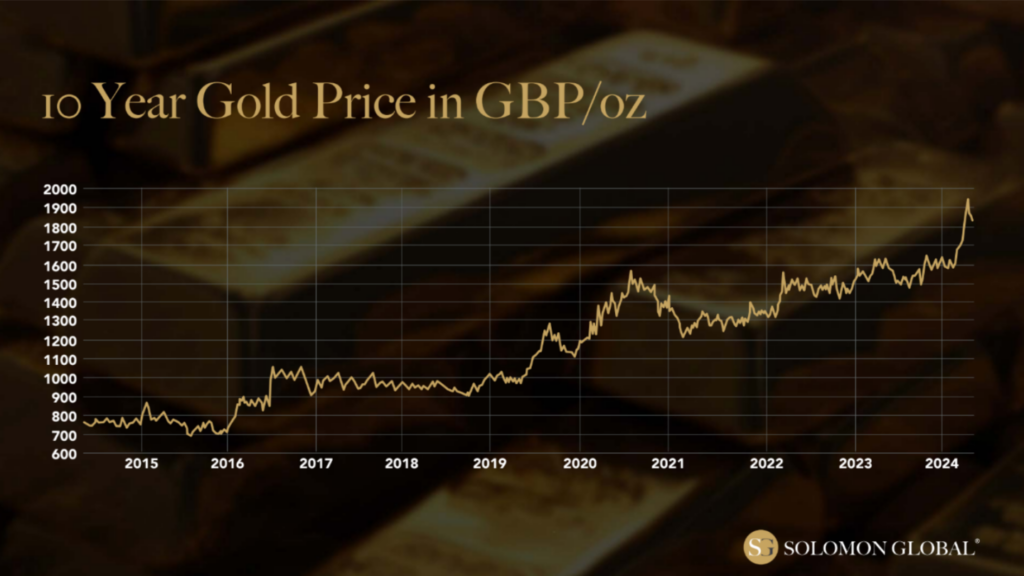
Gold price over the last 10 years: a GBP snapshot
These selected monthly averages help put the overall move into context. They are reference points from the same dataset used for the chart, not prices available for a specific coin or bar on a particular day.
- July 2016: £1,017 per troy ounce
- June 2018: £965 per troy ounce
- June 2020: £1,383 per troy ounce
- June 2022: £1,495 per troy ounce
- June 2024: £1,830 per troy ounce
- June 2026: £3,171 per troy ounce
The start-to-end change is substantial, but the path was not smooth. Monthly averages fell as well as rose, and the series reached a monthly high of about £3,698 in February 2026 before averaging about £3,171 in June.
What the 10-year GBP chart shows
2016–2019: a relatively contained range
Gold began this period close to £1,000 per troy ounce and moved through a comparatively narrow range for much of the following three years. The monthly series was below its July 2016 starting point at several stages before strengthening during 2019.
2020–2021: a sharp repricing
The chart then shows a clear step higher during 2020. Pandemic-era uncertainty, changing interest-rate expectations and strong demand for perceived defensive assets all coincided with this move. These factors can help explain market conditions, but a price chart alone cannot prove that any single event caused a particular change.
2022–2024: renewed growth
Monthly GBP prices remained above their pre-2020 range and rose again through 2023 and 2024. By June 2024, the monthly average in this series was approximately £1,830 per troy ounce.
2025–mid-2026: acceleration and volatility
The steepest part of this 10-year chart appears from 2025 into early 2026. The monthly average reached approximately £3,698 in February 2026, followed by a lower June average. This is an important reminder that a strong long-term trend can still include meaningful short-term falls.
Why the UK gold price changes
There is no single driver of the GBP gold price. Several forces can operate at the same time:
- The international gold price: gold is commonly quoted globally in US dollars per troy ounce, so changes in the underlying dollar price feed into UK pricing.
- The GBP/USD exchange rate: if sterling weakens against the dollar, the same dollar gold price converts into more pounds. A stronger pound can have the opposite effect.
- Interest-rate expectations: changes in expected interest rates and real yields can affect the relative appeal of an asset that does not pay interest.
- Inflation expectations and market risk: demand can change as investors reassess purchasing power, financial stability or geopolitical risk.
- Physical and investment demand: central-bank activity, investment flows, jewellery demand, recycling and mine supply can also influence the market.
These relationships are not fixed. Different drivers can offset one another, and their importance can change over time.
Gold, inflation and purchasing power
Gold is often discussed as a possible store of value, but it does not track UK inflation consistently month by month or year by year. The Office for National Statistics consumer price inflation release measures changes in household prices, while the gold chart measures the market price of a globally traded asset. They answer different questions.
Anyone comparing gold with inflation should therefore consider the period selected, the price paid, any costs of ownership and the price available when selling. A rising historical gold price does not guarantee protection from inflation over a future holding period.
How UK buyers should interpret the chart
- Monthly average is not live spot: the latest point is the average for June 2026, so it will differ from today’s continuously changing market price.
- Spot is not a retail product price: a physical coin or bar can include a product premium, manufacturing or collectability factors, delivery costs and a dealer spread.
- Buying and selling prices differ: the gap between them affects the result an owner may realise.
- Currency matters: UK buyers can see the GBP price move even when the US-dollar gold price is comparatively stable.
- History is not a forecast: this chart describes a past period and should not be extrapolated as a prediction.
Sources and calculation method
- We used the World Bank Commodity Markets monthly gold-price series, expressed in US dollars per troy ounce.
- We matched each month with the Bank of England monthly average USD-per-GBP exchange rate, series XUMAUSS.
- For each month, the USD gold price was divided by the number of US dollars per pound to estimate GBP per troy ounce.
- The chart contains 120 monthly observations from July 2016 to June 2026, the latest complete month included in this analysis.
Rounding is to the nearest pound in the chart and snapshot above. Source providers may revise historical data, and other reputable datasets can differ slightly because of timing, benchmark or averaging conventions. For additional market context, see the World Gold Council gold-price data.
Explore gold investment options
If you are researching physical gold, start with our guide to investing in gold in the UK. You can also explore our gold bullion overview, compare best-value gold coins or review best-value gold bars.
Important information
This article is for general information only. It is not personalised investment, tax or legal advice, and it does not recommend that gold is suitable for any particular person. Product values can fall as well as rise, and past performance is not a guide to future results. If you need advice about your circumstances, speak to an appropriately authorised professional.